Korean cuisine is no longer unfamiliar in Germany. Driven by the waves of K dramas and K pop, interest in Korean culture has steadily grown, resulting in a continuous influx of guests experiencing Korean food for the very first time. Having worked in Korean restaurants in Germany for several years, I have met thousands of customers. Interestingly, almost all of them ask similar questions. At first, I thought they were just simple expressions of curiosity, but over time I realized that these questions reflect fascinating cultural differences in how Germans perceive Korean food.
Surprisingly, the menu items ordered most frequently by German customers are not very diverse. First time visitors generally choose Bulgogi, Bibimbap, Japchae, and Korean BBQ. Bulgogi, in particular, is one of the most popular items because its sweet marinade and tender beef appeal to people of all ages without feeling overwhelming.
On the other hand, Korean customers often look for stronger flavors and familiar comfort foods like Kimchi stew, Kimchi jjigae, Stir fried pork, Jeyuk bokkeum, or Soft tofu stew, Sundubu jjigae. It is always fascinating to see how the dishes people order can differ dramatically depending on their nationality, even when they are sitting in the exact same restaurant.
The most frequent question of all is naturally, “Is all Korean food spicy?”
Many German customers immediately associate Korean food with red sauces and intense heat. Before ordering, they almost always double check by asking, “Is it too spicy?”
Whenever I get this question, I explain that Korean cuisine features a wide variety of flavors. I tell them that dishes like Bulgogi or Galbi are sweet, Japchae is soy sauce based, and comforting soups like Seolleongtang or Gomtang are completely non spicy.
Hearing these explanations often gives hesitant guests the confidence to try something completely new.
Explaining the level of spiciness is also quite an entertaining task. This is because there is a significant gap between what Koreans consider “a little spicy” and what Germans perceive as “a little spicy.”
Instead of simply saying, “It’s a little mild,” I try to be more descriptive.
“It just makes your mouth feel warm.”
“It’s manageable even if you aren’t great with spicy food.”
“It’s on the mild side by Korean standards.”
Sometimes, the conversation goes in entirely unexpected directions.
“Just how mild does it have to be to eat?”
Or even jokingly, “Is ketchup spicy by any chance?”
We share plenty of laughs over things like that.
For guests who genuinely love chili peppers, I can prepare things a bit spicier. For beginners, I often serve Gochujang, or Korean chili paste, on the side so they can adjust the heat themselves.
Of course, whenever I make something extra spicy for someone who claims to have a very high tolerance, they sometimes end up unable to finish it and send it back.
I once heard that Europeans sometimes have a hidden sense of pride when it comes to eating spicy food. Perhaps that helps explain why products like Buldak ramen suddenly became so popular throughout Europe.
The dining styles of Korean and German customers also reveal interesting contrasts.
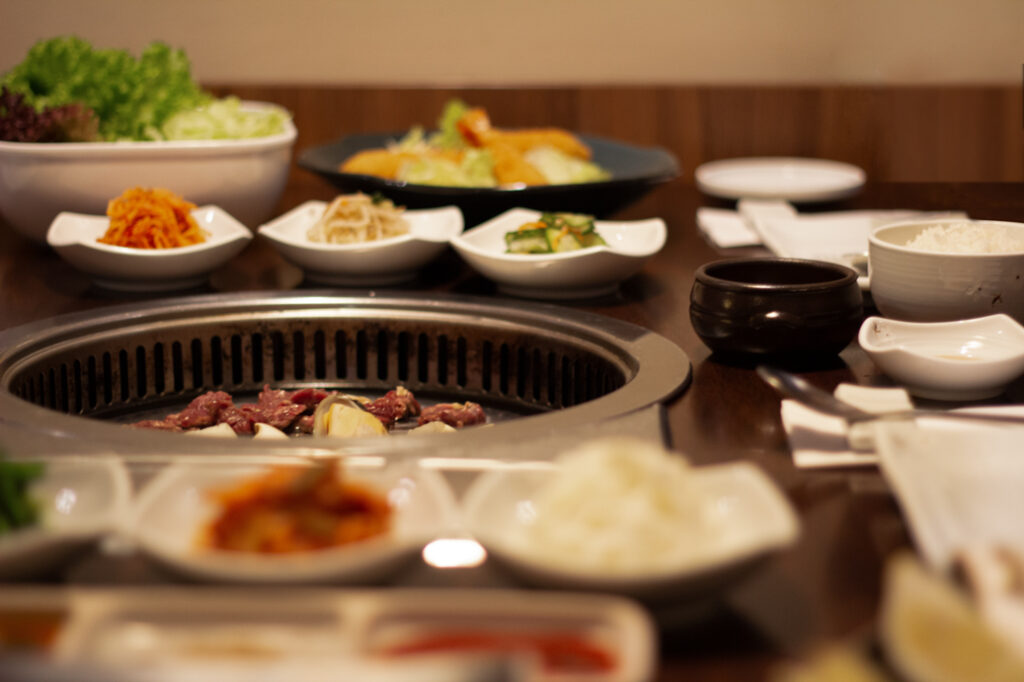
Korean customers naturally share side dishes, known as banchan, wrap meat in lettuce, and enjoy sharing several dishes together. In contrast, German guests are often surprised when they first learn that banchan are completely free. Some even mistake the lettuce leaves used for wrapping meat as simple plate decoration.
However, once you explain how to eat them, most guests thoroughly enjoy experiencing this new dining culture.
In Korea, people often start eating the banchan before the main dishes arrive. Because banchan can include a complex combination of flavors such as sweet, sour, salty, and bitter, they function somewhat like an appetizer in Western dining.
At the same time, however, they also act as supporting elements during the main meal. They gently prepare the palate without overpowering it and help bring out the flavors of the main dishes.
You could compare it to building design, where different flavors and textures are carefully stacked layer by layer.
These small conversations and questions are much more than a routine ordering process. They are valuable opportunities to introduce Korean culture.
I believe that running a Korean restaurant is about more than simply selling food. It is about helping guests experience Korean culinary culture, dining etiquette, and the unique ways Koreans enjoy their meals.
There is no greater reward than hearing a customer say,
“I’m definitely bringing my friends back next time.”
Or,
“I want to eat this again when I travel to Korea.”
Those moments remind me why introducing Korean food and culture to people in Germany is so meaningful.
Schreibe einen Kommentar