
Why are Korean audiences fighting for IMAX tickets to see a 2,700-year-old Greek story?
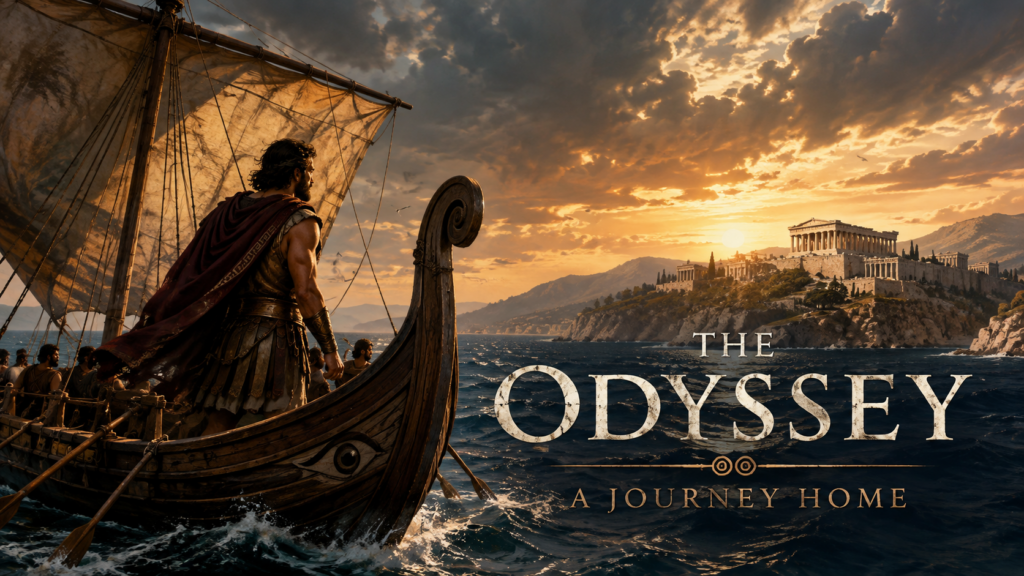
Christopher Nolan’s The Odyssey has become much more than another Hollywood blockbuster in South Korea.
Since its Korean release on August 5, 2026, the movie has attracted millions of Korean moviegoers and created an unusual phenomenon around IMAX screenings, ticket reservations, ticket resales and even the original Homeric epic.
As of August 23, The Odyssey had already surpassed 7 million admissions in South Korea.
So what makes this ancient Greek story such a huge hit in modern Korea?
Christopher Nolan Is a Big Deal in South Korea
The first reason is simple: Christopher Nolan has a huge following in Korea.
For Korean audiences, Nolan is more than a Hollywood director. His name has become a kind of brand.
Movies such as The Dark Knight, Inception, Dunkirk, Tenet and Oppenheimer have all attracted significant attention in Korea.
But perhaps the most important example is Interstellar.
Released in Korea in 2014, Interstellar eventually attracted more than 10 million moviegoers, an extraordinary achievement in the Korean market.
That success helped establish Nolan as one of the few foreign directors whose name alone can generate enormous anticipation among Korean audiences.
So when Nolan announced that his next major project would be The Odyssey, Korean movie fans were already paying attention.
A 2,700-Year-Old Story Becomes a Blockbuster
The Odyssey is based on the ancient Greek epic traditionally attributed to Homer.
The story follows Odysseus, the king of Ithaca, as he attempts to return home after the Trojan War.
His journey is anything but simple.
He encounters the Cyclops, the Sirens, Circe, Scylla and other supernatural dangers. He eventually spends years away from home while his wife, Penelope, waits for him in Ithaca.
His son, Telemachus, also grows up without his father.
Although the story is thousands of years old, its central themes are surprisingly familiar:
home, family, war, identity, loyalty and the desire to return home.
But there is another reason audiences are interested.
Most people already know the basic story.
The question is not necessarily “What happens?”
It is:
“How will Christopher Nolan show it?”
Why Korean Audiences Are Obsessed With IMAX
This is where things get particularly interesting.
Nolan’s The Odyssey was filmed with IMAX cameras, including 70mm IMAX film, and the movie was designed to be experienced on a huge screen.
That has created enormous demand for IMAX screenings in South Korea.
And one theater has become the center of the phenomenon:
Yongsan CGV IMAX
Located in Seoul, CGV Yongsan IMAX is widely regarded by Korean movie fans as the ultimate place to watch the film.
Korean fans have nicknamed it “Yong-a-mac”, combining “Yongsan” and “IMAX.”
Why is it so special?
The theater can present the movie in the expanded 1.43:1 IMAX aspect ratio, allowing viewers to see more of the image than in most conventional theaters.
For a movie specifically designed around large-format photography, that difference matters.
And Korean moviegoers know it.
Getting an IMAX Ticket Can Be Harder Than Watching the Movie
When new Odyssey IMAX tickets become available, thousands of people may try to book them at the same time.
Popular screenings can sell out almost immediately.
Some Korean movie fans repeatedly refresh ticketing websites, hoping another customer will cancel a reservation.
Others book screenings at unusual times — sometimes after midnight or early in the morning — simply because those are the only available seats.
At the height of the Odyssey craze, tickets with an official price of roughly 20,000 Korean won were reportedly being resold for 100,000–200,000 won, with some transactions reportedly exceeding 300,000 won.
That is roughly 5–15 times the original price.
The phenomenon became serious enough that authorities began receiving reports about suspected ticket scalping.
Why Would Anyone Pay That Much?
For someone unfamiliar with Korean movie culture, this may seem completely irrational.
Why pay €70, €100 or even more for a movie ticket that originally costs around €13?
Part of the answer is that the movie theater itself has become part of the experience.
Streaming has changed the way people watch movies.
Today, audiences can watch huge numbers of films from their homes.
Because of that, some moviegoers are increasingly looking for movies that justify going to a theater.
A three-hour Christopher Nolan epic filmed with IMAX cameras is exactly that kind of movie.
For these viewers, watching The Odyssey on a phone, laptop or ordinary television simply isn’t the same experience.
Korean Movie Culture: The “Best Possible Version”
There is also something distinctive about Korean movie culture.
Many Korean movie fans do not simply ask:
“Did you watch the movie?”
They may ask:
“Which theater did you watch it in?”
Was it IMAX?
Dolby Cinema?
A premium sound theater?
Did you watch it at Yongsan?
Did you see the 1.43:1 version?
This has created a kind of movie-going optimization culture.
Fans compare screens, sound systems, seats and aspect ratios.
For some people, finding the best possible theater is almost as important as seeing the movie itself.
With The Odyssey, this culture has reached another level.
The Original Book Is Also Becoming Popular
Interestingly, the movie’s popularity has spread beyond cinemas.
Books about Homer’s Odyssey have suddenly attracted more attention in Korea.
This is known as a “screen-seller” phenomenon — when a movie adaptation causes people to buy or read the original book.
Korean bookstores have reported a sharp increase in sales of books related to The Odyssey following the movie’s release.
Some readers want to compare Nolan’s version with Homer.
Others want to understand the mythology behind characters such as Odysseus, Penelope, Telemachus and the Cyclops.
And some simply want to know more about the story after watching the movie.
This is perhaps one of the most fascinating aspects of the Korean Odyssey phenomenon.
A Hollywood movie has encouraged people to read a piece of literature that was written roughly 2,700 years ago.
Why Does an Ancient Greek Story Still Work?
The success of The Odyssey raises an interesting question.
Why do stories from ancient Greece still work today?
Because the world has changed, but people haven’t changed that much.
Odysseus wants to go home.
Penelope waits for her husband.
Telemachus struggles with growing up without his father.
The characters experience war, loss, temptation, loneliness and uncertainty.
These are not specifically Greek problems.
They are human problems.
And that may be why an ancient epic can still connect with a modern Korean audience.
The Korean Box Office Race Is Still Going
The movie’s Korean journey is not over yet.
After passing 7 million admissions, attention is now turning toward the possibility of reaching 10 million.
That would put The Odyssey in the small group of movies capable of attracting 10 million Korean moviegoers.
It would also give Christopher Nolan another extraordinary achievement in South Korea following the success of Interstellar.
Whether it ultimately reaches 10 million or not, however, the movie has already achieved something unusual.
It has turned an ancient Greek epic into a major part of contemporary Korean popular culture.
The Odyssey Has Become More Than a Movie
There is a certain irony in all of this.
Homer’s story is about a man spending years trying to return home.
And thousands of years later, the story has traveled almost as far as Odysseus himself.
From ancient Greece…
to Hollywood…
and finally to South Korea.
In Korea, people are not only watching The Odyssey.
They are discussing it, buying the original book, comparing theater formats, fighting for IMAX tickets and debating whether the experience is worth paying a premium for.
That may be the real reason for the movie’s success.
The story is ancient, but the way people experience it is completely modern.
And perhaps that is exactly what makes The Odyssey so fascinating in Korea.
A 2,700-year-old story has found a new home in one of the world’s most enthusiastic movie cultures.
If you are interested in experiencing Korean movie culture for yourself, visiting a premium cinema in Seoul is an experience worth adding to your Korea itinerary.
Schreibe einen Kommentar