
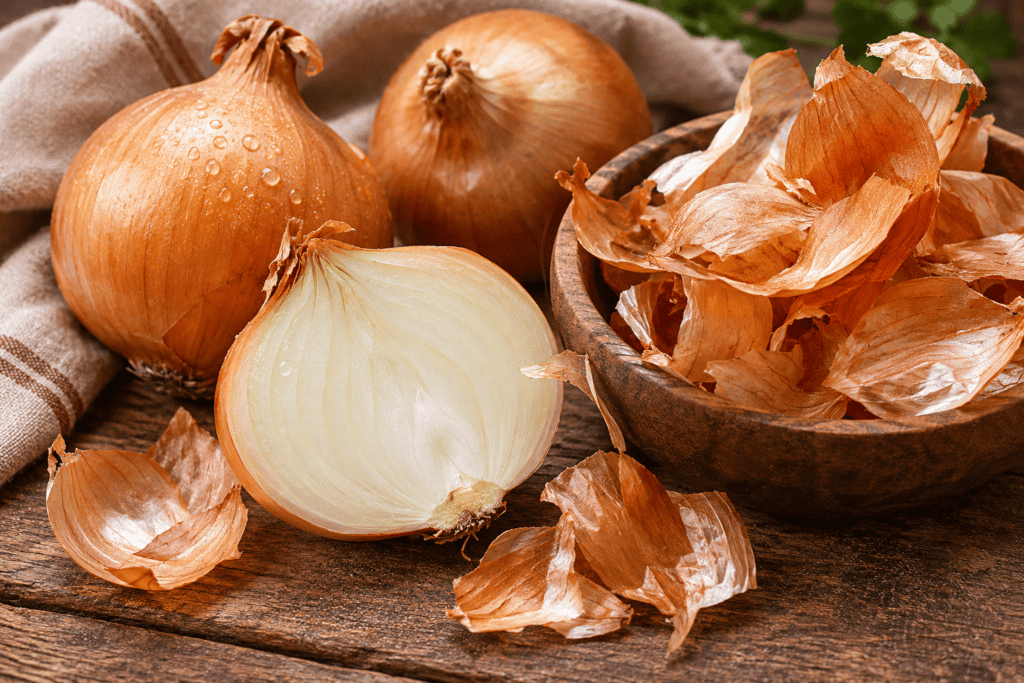
Onions are among the most familiar ingredients in kitchens around the world. They are used in soups, stews, sauces, stir-fries and countless traditional dishes. Their flavor changes dramatically during cooking: the sharp taste of raw onion gradually becomes milder, sweeter and more complex when heated.
But there is more to an onion than its familiar white flesh. Its outer layers, particularly the dry brown skin that most people throw away, contain concentrated plant compounds such as quercetin. These compounds have attracted scientific interest because of their antioxidant properties.
Understanding onion benefits means looking beyond traditional health claims. It also means exploring the chemistry behind onion flavor, how cooking changes its compounds, and why onion peels can be useful in everyday cooking.
In this article, we examine the nutritional and scientific background of onions, distinguish traditional beliefs from modern research, and explain how to use onion peels to prepare a flavorful homemade broth.
1. Onion Benefits: What Makes Onions Nutritionally Interesting?
Onions (Allium cepa) belong to the Allium genus, alongside garlic, shallots, leeks and chives. They are widely cultivated and valued not only for their flavor but also for their characteristic sulfur-containing compounds and flavonoids.
Fresh onions consist largely of water, with carbohydrates making up much of their remaining weight. They also provide small amounts of dietary fiber, vitamin C, vitamin B6, folate and minerals such as potassium.
However, two groups of compounds are particularly interesting when studying onion benefits:
- Flavonoids, especially quercetin, which are associated with antioxidant activity.
- Organosulfur compounds, which contribute to the distinctive aroma and pungency of onions.
These compounds are not distributed evenly throughout the onion. Their concentrations vary depending on the variety, growing conditions, storage, and the part of the bulb being examined.
Quercetin: One of the Most Studied Compounds in Onions
Quercetin is a naturally occurring flavonoid found in many fruits and vegetables, including apples, berries, tea and onions.
It is particularly abundant in the outer layers of many onion varieties. The dry brown skin and the outer fleshy layers can contain substantially more quercetin than the inner edible portions.
Quercetin has been investigated for several biological properties:
- Antioxidant activity
- Modulation of inflammatory pathways
- Effects on blood vessel function
- Interactions with cellular signaling pathways
In laboratory studies, quercetin can help neutralize certain reactive molecules and influence processes associated with oxidative stress.
Oxidative stress occurs when the production of reactive molecules exceeds the body’s ability to control them. It is involved in several biological processes associated with aging and chronic disease.
However, laboratory findings do not automatically translate into proven health benefits in humans. The amount absorbed from food, individual metabolism and the overall dietary pattern all influence how these compounds may affect the body.
Therefore, onions can be considered a useful source of dietary flavonoids, but they should not be described as a treatment for cardiovascular disease or other medical conditions.
Sulfur Compounds: The Chemistry Behind Onion’s Sharp Aroma
The characteristic smell of freshly cut onions comes from sulfur-containing compounds.
Inside an intact onion, certain sulfur-containing precursors are stored separately from the enzymes that transform them. When the onion is cut, crushed or damaged, these substances come into contact.
An enzyme called alliinase-related cysteine sulfoxide lyase helps initiate a series of reactions that produce different sulfur-containing compounds.
One of the most familiar results is the volatile compound responsible for irritating the eyes when cutting onions.
The exact composition of these compounds changes over time and depends on the onion variety and preparation method.
This chemistry explains why freshly cut onions smell sharp and pungent, while cooked onions develop a much softer aroma.
It is important not to confuse onion chemistry with garlic chemistry. Garlic is particularly known for allicin formation, whereas onions produce a different mixture of sulfur compounds and a distinct tear-inducing factor.
2. Why Do Onions Become Sweeter When Cooked?
Raw onions have a distinctive sharpness that can sometimes dominate a dish. Yet when onions are slowly cooked, their flavor changes considerably.
They become softer, sweeter and more rounded.
This transformation is not caused by a single chemical reaction. Several processes take place simultaneously.
Heat Changes the Balance of Flavor
Onions naturally contain sugars such as glucose, fructose and sucrose.
When onions are heated, their pungent sulfur compounds are reduced or transformed through evaporation and chemical reactions. As the sharp aroma becomes less dominant, the natural sweetness becomes easier to perceive.
Water loss also concentrates the remaining sugars and flavor compounds.
When onions are sautéed slowly, additional browning reactions can develop complex aromas. Under suitable conditions, caramelization and Maillard-related reactions contribute to the characteristic flavor of cooked onions.
This is why slowly sautéed onions taste different from onions that have simply been boiled.
Raw, Sautéed and Boiled Onions: How They Differ
Different cooking methods create different flavor profiles.
Raw onions
Raw onions retain their characteristic pungency and crisp texture. Their sulfur chemistry is particularly noticeable immediately after cutting.
Sautéed onions
As onions soften and brown, their sharpness decreases. Their natural sweetness becomes more prominent, while browning reactions create deeper and more complex aromas.
Boiled onions
When onions are simmered in water, some water-soluble compounds move into the cooking liquid. Their texture becomes soft, and their flavor is transferred into soups, stocks and sauces.
There is no single cooking method that preserves every compound equally well. The best method depends on whether the goal is a fresh aroma, sweetness, a rich broth or a particular nutritional profile.
3. Onion Benefits and Cardiovascular Health: What Does Research Say?
One of the most common traditional claims about onions is that they are beneficial for blood circulation.
This belief is often associated with quercetin and sulfur-containing compounds.
Modern research has investigated whether these compounds may influence blood vessel function, inflammation, oxidative stress and certain markers related to cardiovascular health.
Quercetin and Blood Vessel Function
Quercetin has been studied for its potential effects on endothelial function.
The endothelium is the thin layer of cells lining the inside of blood vessels. It plays an important role in regulating vascular tone and maintaining normal circulation.
Some human studies and research reviews suggest that quercetin supplementation may influence certain cardiovascular measurements, including blood pressure in some populations.
However, the results are not uniform. Effects can depend on the dose, duration, study population and form of quercetin used.
Eating onions as part of a balanced diet is not equivalent to taking a concentrated quercetin supplement.
There is currently no sound basis for claiming that eating onions literally cleans the inside of blood vessels or dissolves existing blood clots.
Onion Sulfur Compounds and Platelet Activity
Certain compounds found in Allium vegetables have attracted attention because of their possible effects on platelet activity.
Platelets are blood components that help form clots when a blood vessel is injured.
Laboratory studies have investigated whether some onion-derived compounds can influence platelet aggregation and other processes involved in clot formation.
These findings are scientifically interesting, but they should not be interpreted as evidence that eating onions prevents thrombosis or replaces prescribed cardiovascular medication.
The distinction between laboratory activity and a demonstrated clinical benefit is essential.
4. Onion Peels: Why the Part We Throw Away Deserves Attention
Most people remove the dry brown outer layers of onions before cooking. These layers are usually considered inedible waste.
Yet onion peels are particularly interesting from a food chemistry perspective.
Research has shown that the outer layers of onions can contain substantially higher concentrations of certain flavonoids, especially quercetin, than the inner edible portions.
This is one reason onion peel extracts are frequently studied in food science and nutritional research.
Why Is Quercetin Concentrated Near the Outer Layers?
Plants produce flavonoids as part of their natural protective systems.
These compounds participate in responses to environmental stress, including exposure to sunlight and other external conditions.
The outer layers of an onion are directly exposed to the surrounding environment during growth and storage. Their chemical composition differs from that of the protected inner layers.
As a result, the outer tissues can accumulate higher concentrations of certain protective plant compounds.
However, the exact concentration varies significantly by onion variety, color, growing conditions and analytical method.
It is therefore more accurate to say that onion outer layers are generally richer in quercetin than to claim that every onion peel contains a fixed amount or a specific multiple of the inner flesh.
Does Red Onion Skin Contain More Quercetin?
Red, yellow and white onions differ in their flavonoid profiles.
Yellow onions are often rich in quercetin and its derivatives, while red onions contain additional pigments called anthocyanins.
Anthocyanins are responsible for many of the red, purple and blue colors found in plants. They also have antioxidant activity in laboratory studies.
The color of an onion can therefore provide clues about its plant compounds, but it does not establish that one variety is always healthier than another.
The amount of quercetin depends on more than color alone.
5. Onion Peel Broth: Turning Kitchen Waste into Flavor
The nutritional interest of onion peels is only one reason to keep them.
From a cooking perspective, onion peels can also contribute color, aroma and subtle flavor to homemade broth.
Rather than discarding every outer layer, clean onion skins can be collected and used in soups, stews and vegetable stocks.
This is a simple example of a zero-waste cooking approach: making better use of ingredients that would otherwise be thrown away.
What Does Onion Peel Add to Broth?
When onion peels are simmered in water, some of their water-soluble compounds move into the liquid.
The result is a broth with a warm golden-brown to amber color, depending on the amount and type of peel used.
Onion peels can contribute:
- A mild onion aroma
- A subtle earthy and roasted impression
- Golden-brown color
- Small amounts of extracted plant compounds, including flavonoids
The flavor should be understood as part of a mixture of compounds rather than the result of one single ingredient.
It is also important to distinguish flavor from umami.
The classic umami taste is mainly associated with free glutamate and certain nucleotides, such as inosinate and guanylate. These compounds can work together to create a stronger savory sensation.
Onion peel broth can contribute depth and aroma, but it should not automatically be described as being rich in glutamate. Its flavor is better understood as a combination of onion-derived compounds, extracted soluble substances and the ingredients added to the broth.
Why Does Onion Peel Broth Sometimes Taste Bitter?
Longer cooking does not always produce a better broth.
Onion skins contain flavonoids and other compounds that can contribute astringency or bitterness. Excessive extraction may therefore make the liquid less pleasant.
The result also depends on the quantity of peel, the amount of water, the onion variety and the cooking temperature.
For everyday cooking, a gentle simmer is usually a better starting point than prolonged boiling.
The goal is to extract a pleasant aroma and color, not to maximize extraction at any cost.
6. How to Make Homemade Onion Peel Broth
Onion peel broth is easy to prepare with ingredients that are already available in most kitchens.
It can be used as a base for Korean soups and stews, vegetable stock, noodle dishes and sauces.
Ingredients
- Clean outer skins from 2–3 onions
- 600–700 ml water
- Optional: a small piece of dried kelp
- Optional: 1–2 dried shiitake mushrooms
- Optional: the green parts of spring onions or other vegetable trimmings
Preparation
Step 1: Collect the onion peels
Remove the dry outer layers from fresh onions. Avoid skins that are moldy, rotten, unusually dirty or damaged.
Step 2: Clean them carefully
Rinse the peels under running water to remove soil and visible debris.
If you plan to store them, make sure they are completely dry before putting them away.
Step 3: Add water
Place the cleaned onion peels in a saucepan and add approximately 600–700 ml of water.
Step 4: Simmer gently
Bring the water to a boil, then reduce the heat and simmer gently for around 10–15 minutes as a starting point.
The liquid should gradually develop a golden-brown color.
Step 5: Strain the broth
Remove the peels and strain the liquid through a fine sieve.
Allow the broth to cool before using or storing it.
The cooking time can be adjusted according to the quantity of peel and the flavor you want. If the broth becomes too bitter or astringent, reduce the amount of peel or shorten the simmering time next time.
How to Use Onion Peel Broth in Everyday Cooking
Onion peel broth is versatile and can be used in many dishes.
Korean soybean paste stew (Doenjang-jjigae)
Use onion peel broth instead of plain water to give the stew a warmer color and a more rounded vegetable background.
Beef bone soup (Gomtang)
A small amount can be used as part of a blended stock, although it should not replace the main beef bone broth. Its role is to contribute a subtle vegetable aroma and color.
Korean chicken soup (Baeksuk)
Onion peel broth can be combined with garlic, spring onion, ginger and other aromatics when preparing chicken stock.
Vegan ramen and vegetable broth
Combine onion peels with dried shiitake mushrooms and kelp to create a savory vegetable base.
For a stronger umami profile, dried shiitake mushrooms are especially useful because they contain guanylate, a nucleotide that can enhance the savory taste of glutamate-containing ingredients.
7. Can Onion Peels Be Used to Make Natural Seasoning Powder?
Another way to make use of onion peels is to dry them and turn them into a seasoning ingredient.
This approach can reduce food waste while adding a subtle onion aroma to homemade seasoning blends.
However, onion peels are fibrous and can have a stronger bitter or earthy taste than the edible flesh. They should therefore be used in moderation.
How to Prepare Onion Peel Powder
- Select clean, dry outer onion skins.
- Remove any damaged or moldy pieces.
- Dry them thoroughly using a food dehydrator or another suitable drying method.
- Once completely dry, grind them into a fine powder.
- Store the powder in a clean, dry, airtight container.
The powder can be used in small quantities in vegetable stock blends, soups, sauces and seasoning mixtures.
For a more balanced flavor, combine it with dried mushrooms, roasted vegetables or other herbs.
8. Does Cooking Destroy the Benefits of Onion Peels?
Cooking changes the chemical composition of onions, but it does not mean that all beneficial compounds disappear.
Some sulfur compounds are volatile and can be reduced during heating. Quercetin and related flavonoids behave differently.
Research on onion processing has shown that the measured concentration and extractability of flavonoids can change depending on the cooking method, temperature, duration and amount of water used.
For example, boiling can transfer water-soluble compounds from the onion tissue into the cooking liquid.
If that liquid is discarded, some extracted compounds are lost from the meal. If it is used as a soup or broth, those compounds may remain part of the dish.
This is one practical reason why cooking methods matter.
Rather than assuming that raw onions are always healthier or that long boiling extracts everything beneficial, it is more useful to consider the whole cooking process.
A broth that uses the cooking liquid is a simple way to make use of compounds that have moved from the onion into the water.
9. Safety and Practical Considerations
Onion peels can be useful in cooking, but they should be handled carefully.
Use clean onions. Choose onions without mold, rot or signs of contamination.
Wash before use. Remove visible soil and debris under running water. Washing does not guarantee the removal of every pesticide residue, so choose a reliable source and follow normal food hygiene practices.
Avoid moldy peels. Do not use outer skins that are damp, spoiled or visibly moldy.
Do not assume organic means sterile. Organic onions can still carry soil and microorganisms, so cleaning remains important.
Avoid excessive extraction. Too much peel or prolonged boiling can produce an unpleasant bitter or astringent flavor.
Store broth safely. Cool the broth promptly, refrigerate it in a clean covered container and use it within a few days, or freeze it for longer storage.
People who have an onion allergy or intolerance should avoid onion peel preparations as well.
10. Onion Benefits: A Small Ingredient with More to Offer
Onions are valuable for much more than their ability to add sweetness and aroma to food.
Their edible flesh provides nutrients and distinctive sulfur compounds, while their outer layers contain concentrated flavonoids such as quercetin.
Scientific research continues to investigate how these compounds interact with oxidative stress, inflammation and cardiovascular processes. Although many findings are promising, they do not establish onions as a medicine or a replacement for medical treatment.
From a culinary perspective, however, onion peels offer a practical benefit that anyone can appreciate.
They can add color and subtle flavor to homemade broth, complement dried mushrooms and kelp, and help reduce unnecessary food waste.
The next time you prepare onions, consider saving a few clean outer skins instead of throwing them away.
Sometimes, a deeper and more satisfying broth begins with an ingredient that most people never thought to use.
References
- Slimestad, R., Fossen, T., & Vågen, I. M. (2007). Onions: A source of unique dietary flavonoids. Journal of Agricultural and Food Chemistry, 55(25), 10067–10080. https://doi.org/10.1021/jf0712503
- Jones, M. G., Hughes, J., Tregova, A., Milne, J., Tomsett, A. B., & Collin, H. A. (2004). Biosynthesis of the flavour precursors of onion and garlic. Journal of Experimental Botany, 55(404), 1903–1918. https://doi.org/10.1093/jxb/erh138
- Suleria, H. A. R., Butt, M. S., Anjum, F. M., Saeed, F., & Khalid, N. (2015). Onion: Nature protection against physiological threats. Critical Reviews in Food Science and Nutrition, 55(1), 50–66. https://doi.org/10.1080/10408398.2011.646364
- National Center for Biotechnology Information (NCBI). PubMed literature database. Research on onion flavonoids, quercetin and organosulfur compounds. https://pubmed.ncbi.nlm.nih.gov/
Editorial Note: The health effects discussed in this article reflect current areas of scientific investigation. Laboratory findings, animal experiments and human clinical studies provide different levels of evidence. Onions are foods, not treatments for cardiovascular disease, cancer or other medical conditions.
Schreibe einen Kommentar