When working at a Korean restaurant, there is one question I hear from European guests again and again:
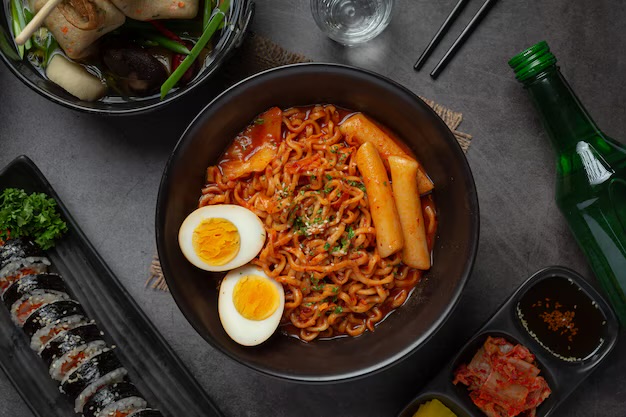
“Is this very spicy?”
For Koreans, a dish may not seem particularly spicy at all, but for someone who is not accustomed to spicy food, the same dish can feel surprisingly intense.
Interestingly, however, it would be wrong to assume that Europeans cannot handle spicy food. In recent years, more and more people across Europe have become interested in Korean cuisine and even actively seek out spicy Korean dishes.
So, how do Europeans actually experience the spiciness of Korean food?
Is “spicy” actually a taste?
We usually talk about five basic tastes: sweet, salty, sour, bitter, and umami.
Interestingly, “spicy” is not one of them.
The reason is quite fascinating.
Spiciness is not perceived in the same way as ordinary tastes. Instead, it is much closer to a sensation caused by the nerves that detect temperature and pain.
One of the main compounds responsible for the heat of chili peppers is capsaicin.
When capsaicin enters the mouth, it activates a receptor called TRPV1.
This receptor is involved in detecting heat and painful stimuli.
That is why eating spicy food does not simply make us think, “This tastes spicy.”
Our mouth may feel hot, burning, tingling, or painful, and we may even start sweating.
In other words, what we commonly call “spiciness” is not really a basic taste. It is a physical sensation created when our nervous system responds to a chemical stimulus.
American neuroscientist David Julius, a professor at the University of California, San Francisco, is well known for his research on the TRPV1 receptor. His discoveries concerning how the body senses temperature and pain contributed to his receiving the 2021 Nobel Prize in Physiology or Medicine.
So when we eat tteokbokki and say, “It’s so spicy!”, our nervous system is actually carrying out a rather complex process.
Why can some people handle spicy food while others cannot?
This is where the difference in food culture becomes interesting.
In Korea, people are exposed to spicy foods from a young age.
Kimchi, kimchi jjigae, tteokbokki, bibim noodles, gochujang and many other foods containing chili are part of everyday Korean cuisine.
For this reason, Koreans often become accustomed to spicy sensations early in life.
On the other hand, for someone who did not grow up eating spicy food regularly, the same amount of capsaicin can feel much more intense.
That is why a Korean person might say,
“It’s not that spicy.”
while someone trying the same dish for the first time might be struggling to get through it.
There is another interesting difference.
Koreans who are accustomed to spicy food can often notice the flavors behind the heat: the aroma of chili, the sweetness of gochujang, the flavor of garlic, and the umami of the seasoning.
For someone experiencing Korean spicy food for the first time, however, there may be only one message coming from the brain:
“It’s spicy!”
The heat can overwhelm everything else.
So why do people eat something that hurts?
This is perhaps the most fascinating part of spicy food.
If spiciness is closely connected to pain, why do people deliberately seek it out?
In Korea, people often turn to spicy food when they are stressed, tired, or have lost their appetite.
Eating something spicy can produce heat and sweating, and many people describe the feeling afterward as refreshing or relieving.
Capsaicin is also known to interact with processes related to energy metabolism and to stimulate gastric secretion.
However, this does not mean that spicy food is automatically healthy for everyone. People with conditions such as gastritis or frequent heartburn may actually experience more discomfort from spicy foods.
Ultimately, what matters is not only how spicy something is, but also how accustomed someone is to that sensation.
How do we measure spiciness?
When people compare the heat of different peppers, one measurement often comes up: the Scoville Heat Unit (SHU).
The Scoville scale was developed in 1912 by American pharmacist Wilbur Scoville to measure the pungency of chili peppers.
The higher the number, the hotter the pepper.
For example, Korean Cheongyang chili peppers are generally estimated at around 10,000–30,000 SHU.
The famous Korean spicy noodle Buldak Bokkeum Myun is commonly reported at around 4,400 SHU.
But there are peppers that are in a completely different league.
One of them is Pepper X.
In 2023, Guinness World Records officially recognized Pepper X as the world’s hottest chili pepper.
Its average heat level was measured at an astonishing 2.693 million SHU.
That is considerably higher than its predecessor, the Carolina Reaper, which measured around 1.64 million SHU.
Compared with a Cheongyang chili pepper, Pepper X is in another universe.
For comparison, pure capsaicin is estimated at around 16 million SHU.
Numbers like these show just how extreme the world of spicy food can become.
Why did chili peppers evolve to be spicy?
There is another fascinating story behind chili peppers.
Unlike humans and most other mammals, some birds are largely insensitive to the burning sensation caused by capsaicin.
This is related to differences in the structure and response of their TRPV1 receptors.
From an evolutionary perspective, this has sometimes been explained as a clever strategy developed by chili peppers to spread their seeds.
When mammals eat chili peppers, they tend to chew them, which can damage the seeds.
Birds, however, generally swallow their food without chewing it in the same way.
They can then travel long distances and spread the seeds through their droppings.
In other words, from the chili pepper’s perspective, mammals get a message saying,
“Stay away. I’m too spicy.”
while birds can simply eat the fruit and carry its seeds somewhere else.
It is a surprisingly clever strategy.
Although I doubt the chili pepper ever imagined that humans would eventually say:
“This is painfully spicy… but it’s delicious.”
So how do Europeans experience Korean spiciness?
With all of this in mind, it becomes easier to understand why Korean food can taste dramatically different to someone who is not accustomed to spicy food.
Spiciness is not simply a matter of taste. It is the interaction between a chemical compound such as capsaicin and the body’s systems for detecting heat and pain.
And the more familiar we become with that sensation, the more differently we may experience it.
For someone trying Korean food for the first time, the heat can feel almost like pain.
But after experiencing it several times, the same sensation can become part of the enjoyment.
That is why someone might initially say,
“This is way too spicy!”
and, after trying Korean food several more times, eventually say,
“Can you make it a little spicier?”
What was once perceived as pain has somehow become part of the flavor.
Why do humans enjoy spicy food?
Perhaps the answer lies in something uniquely human.
As Professor Rozin has suggested, humans are unusual among mammals in their ability to enjoy experiences that are inherently unpleasant.
Our bodies may be saying,
“It’s hot!”
“It’s painful!”
while our minds know that we are not actually in danger.
And so we keep eating.
We sweat.
We tear up.
We reach for a glass of water.
And then, somehow, we take another bite.
Perhaps this is where our love of spicy food begins.
Our body is screaming for help, while our mind is saying, “Yeah, but it’s delicious.”
Someone who once said,
“I absolutely cannot eat spicy food,”
may eventually find themselves ordering something even hotter.
In the end, humans really are strange creatures.
We know it hurts, yet we eat it again.
We say it’s too spicy, yet we are already waiting for the next bite.
And perhaps that is the most fascinating charm of Korean spicy food.
What begins as an unfamiliar and almost painful sensation can eventually become part of the flavor.
And before we know it, we are looking for that same heat again.
Schreibe einen Kommentar