One of the things that often surprises foreigners when they visit a Korean restaurant for the first time is seeing several small dishes already placed on the table before the main food arrives.
Kimchi, seasoned bean sprouts, seasoned spinach, stir fried fish cakes, braised potatoes, cucumber salad, spicy shredded radish. The variety can be surprisingly large.
At our restaurant, we also serve six different side dishes as part of every meal, and many of our guests often ask us about them.
These dishes are usually served separately from the main dish.
In Korea, they are called “banchan” (반찬).
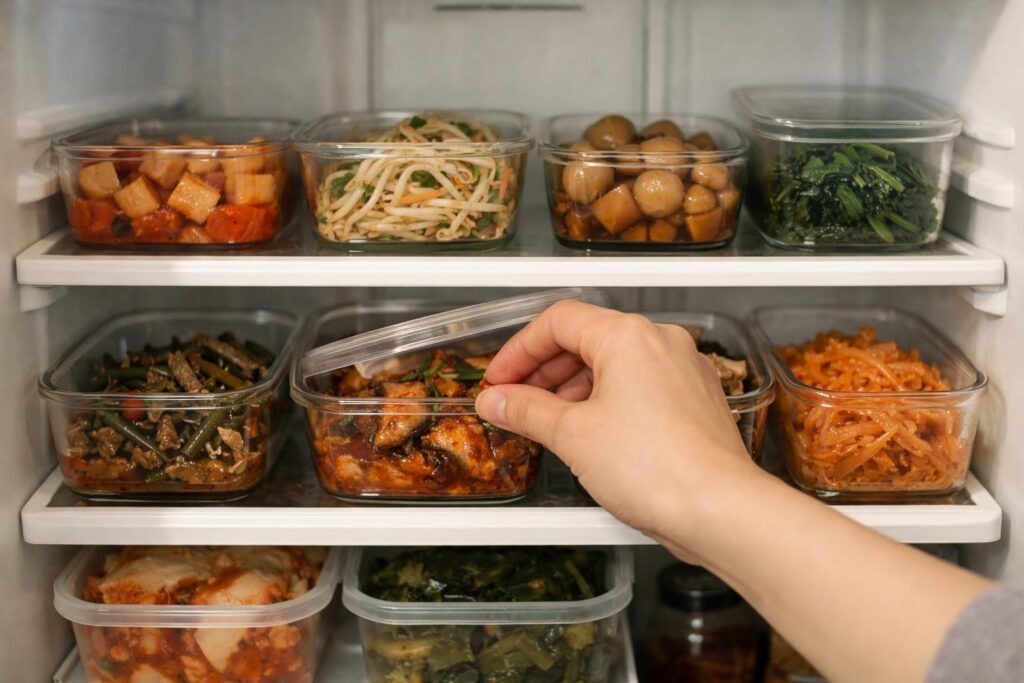
So why do Koreans eat so many side dishes?
It is not simply because Koreans want to eat a lot of food. Korea’s banchan culture has developed over a long period of time and is closely connected to a rice centered way of eating, the use of seasonal ingredients, traditional food preservation methods, and the custom of sharing food around the table.
1. Rice Is at the Center of a Korean Meal
To understand traditional Korean food culture, it is important to understand the role of rice.
In Korea, rice has traditionally been much more than just one dish among many. It has been the center of the meal.
A typical Korean meal consists of rice accompanied by soup or stew and a variety of side dishes.
Banchan help create a balance of flavors when eaten together with rice.
Some are salty, some spicy, some mild, and others slightly sour or refreshing.
You might take a spoonful of rice with a little kimchi, then have another bite with seasoned vegetables. In this way, a single meal allows you to experience many different flavors and textures.
2. A Culture of Eating Small Amounts of Many Different Foods
Korean banchan are generally not meant to be eaten in large quantities.
Instead, the idea is to enjoy many different foods in small portions.
For example, a Korean meal might include kimchi, seasoned bean sprouts, seasoned spinach, stir fried fish cakes, stir fried dried anchovies, and a Korean rolled omelet.
Each dish may be served in a small portion, but together they create a meal with a wide variety of flavors.
The same bowl of rice can taste completely different depending on which side dish you eat with it.
3. Banchan Are Closely Connected to Korea’s Tradition of Food Preservation
When talking about Korean banchan culture, it is impossible to leave out kimchi.
For centuries, Koreans developed various ways to preserve ingredients so they could be stored for longer periods of time.
In particular, during the winter, when fresh vegetables were more difficult to obtain, people preserved vegetables by salting or fermenting them. Other ingredients were dried or preserved using traditional sauces and seasonings.
Kimchi, pickled vegetables, fermented seafood, and dried wild greens are all connected to this tradition of food preservation.
As a result, a traditional Korean table often included both foods that could be stored for a long time and freshly prepared dishes.
Living abroad myself, I sometimes wish I could easily get ingredients such as jeotgal, traditional Korean fermented seafood, or wild greens that are readily available in Korea.
Unfortunately, many of these ingredients are difficult to find outside Korea, and that is something I personally find quite disappointing.
Of course, give me just a bowl of kimchi and I could probably finish three bowls of rice in no time! 😄
4. Banchan Change With the Seasons
Korean side dishes are also closely connected to the seasons.
In spring, you can find many dishes made with fresh spring greens and wild vegetables.
During summer, vegetables such as cucumbers and eggplants become more common.
In autumn, a variety of freshly harvested ingredients can be used, while winter traditionally brings preserved foods such as kimchi, pickled vegetables, and dried greens to the table.
In this sense, banchan were not simply foods served alongside a main dish.
They were also a way of making use of whatever ingredients were available during each season.
5. Banchan Are Not Necessarily Made Fresh Every Day
Here is another interesting aspect of Korean food culture.
A banchan does not necessarily have to be prepared specifically for a single meal.
Some side dishes can be kept and enjoyed over several days.
Kimchi, pickled vegetables, stir fried dried anchovies, and jangjorim, braised beef, for example, can be stored in the refrigerator and served in small portions whenever a meal is prepared.
Preparing several side dishes at once can therefore make meals much easier over the following days.
The practice of preparing several banchan in advance and eating them little by little is an important part of traditional Korean home cooking.
6. Banchan Are Different From the Main Dish
Foreigners visiting a Korean restaurant for the first time sometimes think of banchan as appetizers or small starters.
But they are actually a little different.
Banchan are not primarily foods that you eat before the main dish. They are meant to be eaten together with the meal, especially with rice.
Of course, for Western guests who enjoy slightly sour or tangy flavors, the banchan that arrive before the main dish can sometimes be a great way to wake up the palate and get ready for the meal.
For example, when you order Korean grilled pork belly, you may receive kimchi, garlic, lettuce, ssamjang, and other side dishes.
Each side dish creates a different flavor when combined with the meat.
When I explain Korean food to foreign guests, I often tell them that part of the fun is trying different combinations and discovering how each side dish changes the flavor of the main dish.
However, I also understand that some banchan can be intimidating at first.
The brightly colored, heavily seasoned, or spicy looking dishes are not always the first things a foreign guest wants to try.
I have to admit that this is something I find a little disappointing. One of the things I often think about as a restaurant owner is how I can make these unfamiliar side dishes feel more approachable to our guests.
7. A Culture of Sharing Food
Traditional Korean meals were often eaten with several people sitting together around the same table.
While rice and soup were generally served individually, many of the side dishes were placed in the center of the table and shared among everyone.
Because of this, banchan have traditionally been viewed not simply as an individual’s food, but as food for the entire table.
One person might take some kimchi while another takes some seasoned vegetables, with everyone sharing the different dishes together.
This style of eating is also closely connected to the communal nature of Korean food culture.
However, in many Western countries, it is more common for each person to have their own individual plate and eat from their own portion.
So it is understandable that sharing dishes in the middle of the table can feel a little confusing at first.
In fact, we sometimes have a funny situation at our restaurant where we end up giving guests a small pair of tongs for every single side dish because they are not sure how they are supposed to serve themselves!
8. Not Every Korean Meal Is Filled With Side Dishes
There is one important misconception worth clearing up.
Koreans do not always eat ten or more side dishes at every meal.
When having a simple meal at home, a bowl of rice with some kimchi and an egg can be enough. A simple soup or stew with just a few side dishes can also make a complete meal.
The number and variety of banchan also depend greatly on the type of restaurant and the kind of meal being served.
The important characteristic of Korean banchan culture is therefore not simply the number of side dishes, but the idea of enjoying a variety of foods in small portions as part of the same meal.
So, What Do All These Side Dishes Really Mean?
To understand Korean banchan culture, it is important not to simply think, “Koreans eat a lot of food” or that the food is being wasted.
Banchan are the result of a Korean food culture that developed over a very long period of time.
Rice as the center of the meal, the use of a wide variety of ingredients, seasonal cooking, traditional food preservation, and the custom of sharing food around the table all contributed to the Korean banchan culture we know today.
So when you sit down at a Korean restaurant and see a table filled with small dishes alongside your bowl of rice, it is not simply a matter of “getting lots of food.”
Each of those small dishes represents a part of Korean food culture. It represents its history, its seasons, its traditional methods of preserving food, and its tradition of eating together.
And that is one of the reasons banchan can feel so special and unfamiliar to people experiencing Korean food for the first time.
Perhaps the next time you visit a Korean restaurant, instead of looking at those little dishes and wondering, “What am I supposed to do with all of these?”, try a little of each one.
You might discover that the side dishes are not just something that comes with your meal.
They are part of what makes a Korean meal a Korean meal.
Schreibe einen Kommentar